引述:
林郁方指出,未來「萬劍」系統若量產服役,台灣戰機執行「源頭打擊」任務時,就不必冒險深入大陸,可於台海上空,在友軍戰機、各式電戰系統,甚至雄風二E充分支援下,以「萬劍」武器系統對大陸東南沿海內陸軍事目標進行遠距制壓,大幅減少戰機暴露在中共防空火網下的時間。
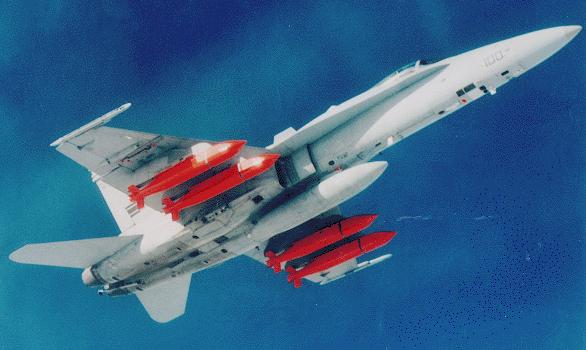
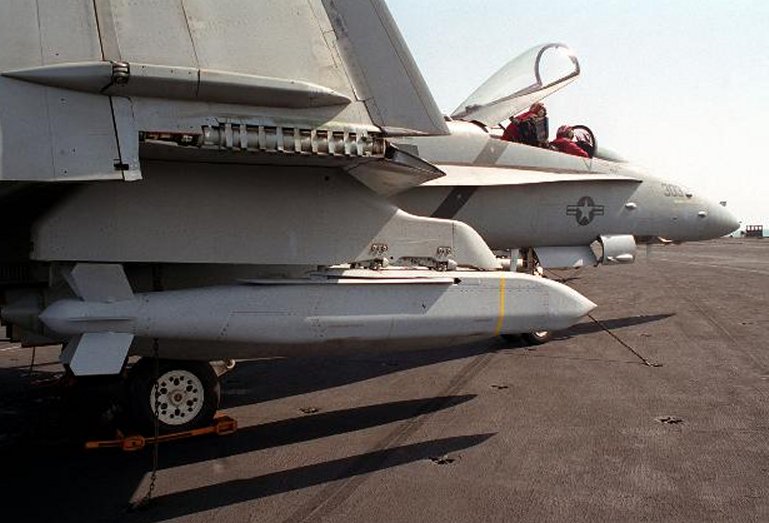
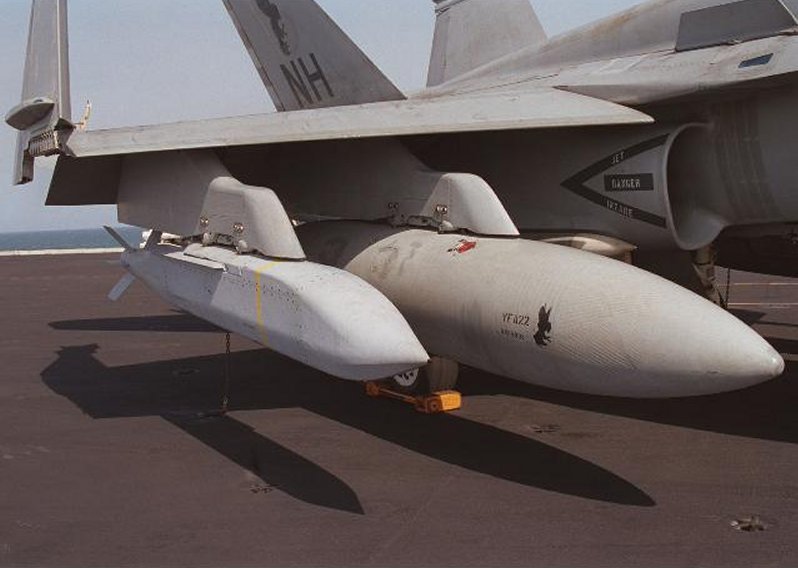
AGM-154A Joint Standoff Weapon [JSOW]
The AGM-154A Joint Standoff Weapon or JSOW is currently under development by Raytheon [Texas Instruments] for the Air Force and the Navy. The AGM-154A (Formerly Advanced Interdiction Weapon System) is intended to provide a low cost, highly lethal glide weapon with a standoff capability. JSOW family of kinematically efficient, air-to-surface glide weapons, in the 1,000-lb class, provides standoff capabilities from 15 nautical miles (low altitude launch) to 40 nautical miles (high altitude launch). The JSOW will be used against a variety of land and sea targets and will operate from ranges outside enemy point defenses. The JSOW is a launch and leave weapon that employs a tightly coupled Global Positioning System (GPS)/Inertial Navigation System (INS), and is capable of day/night and adverse weather operations. The JSOW uses inertial and global positioning system for midcourse navigation and imaging infra-red and datalink for terminal homing. The JSOW is just over 13 feet in length and weighs between 1000-1500 pounds. Extra flexibility has been engineered into the AGM-154A by its modular design, which allows several different submunitions, unitary warheads, or non-lethal payloads to be carried. The JSOW will be delivered in three variants, each of which uses a common air vehicle, or truck, while substituting various payloads.
| AGM-154A (Baseline JSOW)
The warhead of the AGM-154A consists of 145 BLU-97/B submunitions. Each
bomblet is designed for multi-target in one payload. The bomblets have a
shaped charge for armor defeat capability, a fragmenting case for
material destruction, and a zirconium ring for incendiary effects.
|
|
| AGM-154B (Anti-Armor)
The warhead for the AGM-154B is the BLU-108/B from the Air Force's
Sensor Fuzed Weapon (SFW) program. The JSOW will carry six BLU-108/B
submunitions. Each submunition releases four projectiles (total of 24
per weapons) that use infrared sensors to detect targets. Upon
detection, the projectile detonates, creating an explosively formed,
shaped charge capable of penetrating reinforced armor targets.
|
|
| AGM-154C (Unitary Variant) The AGM-154C will use a combination of an Imaging Infrared (IIR) terminal seeker and a two-way data link to achieve point target accuracy through aimpoint refinement and man-in-the-loop guidance. The AGM-154C will carry the BLU-111/B variant of the MK-82, 500- pound general purpose bomb, equipped with the FMU-152 Joint Programmable Fuze (JPF) and is designed to attack point targets. |
Texas Instruments (TI) Defense Systems & Electronics (DS&E) began Engineering and Manufacturing Development (E&MD) of JSOW in 1992. In December 1995, the Navy and Texas Instruments completed Development Test IIB (DT-IIB) at the Naval Air Weapon Center, (NAWC) China Lake and Point Mugu, California, with 10 for 11 successful flights of the AGM-154A BLU-97 dispenser variant.
On January 6, 1997, it was announced that Texas Instruments Defense Systems & Electronics was being purchased by Raytheon Company, Lexington, Massachusetts. The U.S. Navy began Operational Evaluation (OPEVAL) testing in February 1997, after successful development testing and initial operational testing programs. The test program resulted in a 42 for 44 success rate or greater than 96% successful JSOW launches. The Air Force began Development Test & Evaluation (DT&E) flight testing of JSOW on the F-16 at Eglin Air Force Base, Florida, in March 1996. Air Force testing of the baseline JSOW was hindered by less than desired progress in the area of F-16/JSOW integration. There was never a problem in the interface between the weapon and the aircraft. The weapon worked perfectly. The problem that prolonged the testing at Eglin, was with a subassembly of the JSOW, which was not manufactured by Texas Instruments.
AGM-154A (Baseline variant) system entered Low Rate Initial Production (LRIP) on schedule. The $65.9 million LRIP contract was awarded by the Naval Air Systems Command (NAVAIR), in Arlington, Virginia, for 111 JSOW AGM-154A/baseline systems. LRIP for the other two variants are scheduled for FY99 and FY00, respectively. On 29 December 1998 Raytheon Systems was awarded a $133,881,355 firm-fixed-price contract to provide funding for the Full Rate Production Lot 1 of JSOW AGM-154A and the Low Rate Initial Production Lot I of the JSOW AGM-154B (AGM-154A: Navy - 328 and Air Force - 75) (AGM-154B: Navy - 3 and Air Force - 21). Work is expected to be completed by March 2001.
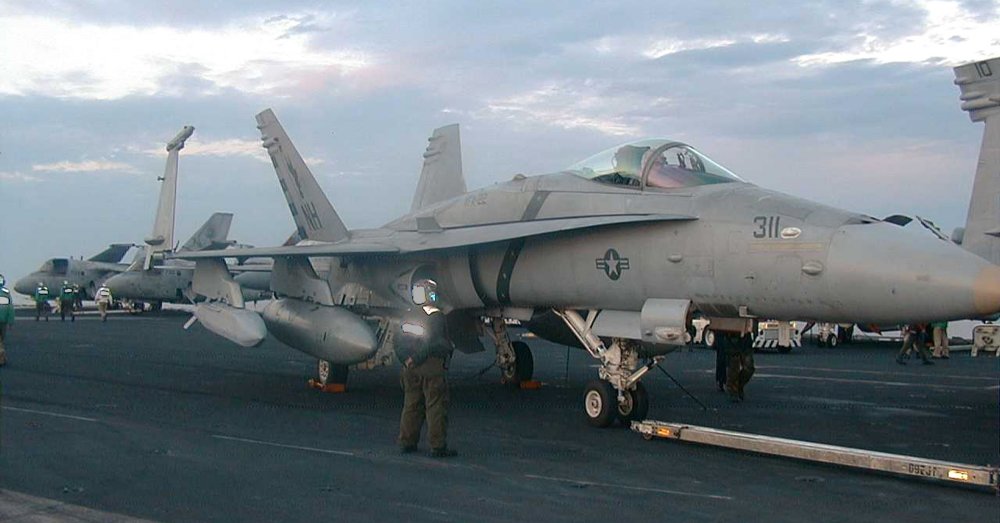
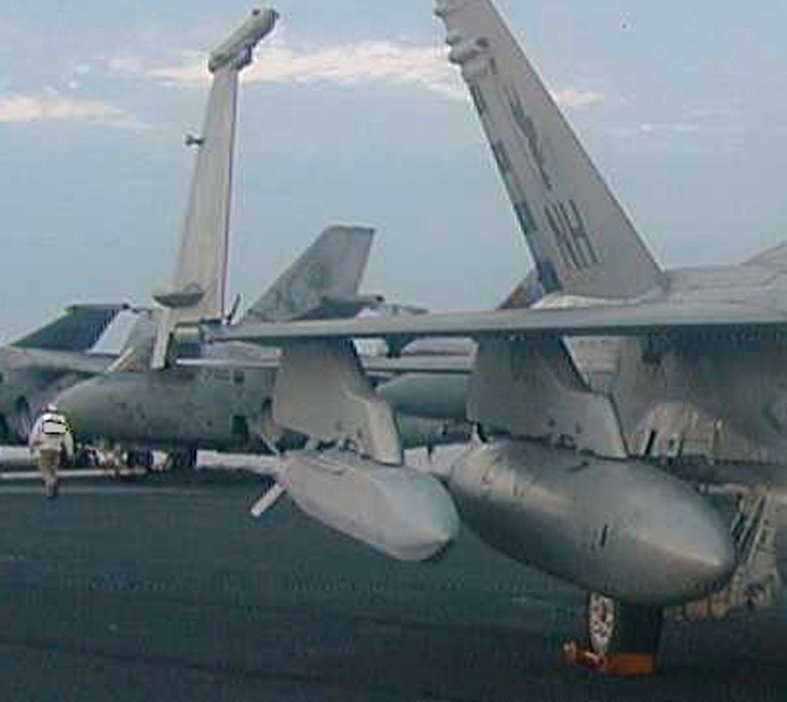
JSOW test articles were deployed in 1997 aboard the USS Nimitz and are currently deployed on the USS Eisenhower. JSOW initial introduction to the operational commands was on the Navy/Marine Corps F/A-18 in mid-1998. As of late 1997 a number of remaining JSOW test assets were on an interim deployment for further operational evaluation. USS Carl Vinson 's air wing first employed the JSOW during combat over southern Iraq on Jan. 25, 1999.
On 29 December 1999 Raytheon Systems Company, Tucson, Ariz., was awarded a $109,573,867 modification to previously awarded contract N00019-99-C-1014 to exercise an option for the full rate production Lot 2 of the Joint Standoff Weapon AGM-154A for the U.S. Navy (414) and U.S. Air Force (74). Work will be performed in Tucson, Ariz., and was expected to be completed by March 2002.
On 23 June 2000 Raytheon was awarded a $5,069,914 modification to previously awarded cost plus incentive fee basic ordering agreement N00019-98-G-0104 for the integration of the Selective Availability Anti-Spoofing Module (SAASM) into the Joint Standoff Weapon (JSOW) System. This effort will bring new production JSOWs delivered after 1 April 2003 in compliance with current Global Positioning System (GPS) security requirements for weapon-based GPS. Work will be performed in Tucson, Ariz., and is expected to be completed by May 2001.
Weapon planning will be accomplished using the Navy's Tactical Automated Mission Planning System (TAMPS) and the Air Force Mission Support System (AFMSS). Aircraft-to-weapon communications will be via the MIL-STD-1760 interface, making inflight programming/targeting possible, as well as preflight data loading. The weapon will be deployed from both carrier- and land-based aircraft, employing insensitive munitions technology. The JSOW will be employed on the following aircraft: F/A-18A/B, C/D, and E/F; AV-8B; F-14A/B and /D; F-16C/D; F-15E; F-117; B-1B; and B-52.
Specifications |
|||
| Mission | Close air support, interdiction, amphibious strike and anti-surface warfare | ||
| Variants |
AGM-154A Baseline |
AGM-154B Anti-Armor |
AGM-154C Unitary |
| Service | Navy and Air Force | Navy and Air Force | Navy |
| Contractor | Raytheon [Texas Instruments] | ||
| Targets | Mobile soft, fixed soft | Mobile hard, mobile soft | Fixed hard, maritime surface |
| First capability | 1998 | 2001 | 2002 |
| Guidance method | GPS/INS | JSOW
airframe -- GPS/INS
BLU-108 submunitions -- two-color infrared sensors |
GPS/INS with a terminal seeker and man- in-the-loop data link |
| Range |
12 nm (24km) Low altitude launch (unpowered) 40 nm (64 km) High altitude launch (unpowered) ->120 nm (200 km) Powered |
||
| Circular Error Probable | |||
| Development cost | $417.9 million | $227.8 million | $452.4 million |
| Production cost | $2,909.7 million | $1,805.7 million | $5,155.9 million |
| Total acquisition cost | $3,327.6 million | $2,033.5 million | $5,608.3 million |
| Acquisition unit cost | $282,000 | $484,167 | $719,012 |
| Production unit cost | $246,585 | $429,929 | $661,013 |
| Quantity | Navy: 8,800;
Air Force: 3,000 |
Navy: 1,200;
Air Force: 3,000 |
Navy 7,800 |
| Platforms | B-1, F-16, F-15E, F/A-18C/D, F/A-18E/F, AV-8B, P-3, S-3 | B-1, F-16 C/D, F-15E, F/A-18C/D, F/A-18E/F, AV-8B, P-3, S-3 | F/A-18C/D, F/A-18E/F, AV-8B, P-3, S-3 |
萬劍過測評 提升空軍遠距戰力
(中央社記者周永捷台北7日電)國民黨立委林郁方今天表示,根據100年國防部預算書,國防部自製研發、代號「萬劍計劃」的機場制壓武器「萬劍」系統,已通過空軍初期作戰測評驗測,有助提升國軍遠距壓制戰力。
林郁方晚間發布新聞稿表示,「萬劍」系統內裝有上百枚次彈頭,具遠距遙攻能力,除可用於破壞、癱瘓中國大陸東南沿海的機場跑道外,對部隊集結區、港口裝卸區、飛彈及雷達陣地等,也有極大殺傷力。
他指出,「萬劍」是國防部斥資近新台幣30億元、耗時數年才開發完成的武器系統,外觀上雖與美國AGM-154「聯合遙攻武器系統」類似,但因開發較晚,又加入不少符合台灣作戰需求的設計,部分性能甚至超過AGM-154。
林郁方說,在馬政府全力支持下,「萬劍」終於在今年上半年通過空軍「初期作戰測評」,未來只要完成與IDF戰機性能提升的整合工程,就可進入量產。國防部預算也透露,為掛載萬劍彈,國防部預定民國100 年和101年再投入經費,提升IDF戰機性能,讓IDF具備「遠距制壓作戰」和「防空制壓作戰」能力。
林郁方指出,未來「萬劍」系統若量產服役,台灣戰機執行「源頭打擊」任務時,就不必冒險深入大陸,可於台海上空,在友軍戰機、各式電戰系統,甚至雄風二E充分支援下,以「萬劍」武器系統對大陸東南沿海內陸軍事目標進行遠距制壓,大幅減少戰機暴露在中共防空火網下的時間。

 台灣窮小子軍事戰略篇 (4)